
Home
High Energy Physics

Main navigation

  • Find us
    • General HEP contacts
    • Experimental Group
    • Theory Group
    • Technicians
    • Getting here
  • Research
    • Research overview
    • Experiment
    • Theory
    • Computational Radiotherapy
    • Intranet
    • Seminars
  • Opportunities
    • Opportunities overview
    • Job Opportunities
    • Graduate Admissions
    • Summer Studentships
  • Outreach
    • Overview
    • Previous Experiments
    • Masterclass (A/AS)
    • Muon Hodoscope
    • Cloud Chamber
    • Spark Chamber
User account menu
  • Log in

Breadcrumb

  1. Home
  2. Previous Experiments
  3. OPAL

Track Trigger

The OPAL Track Trigger

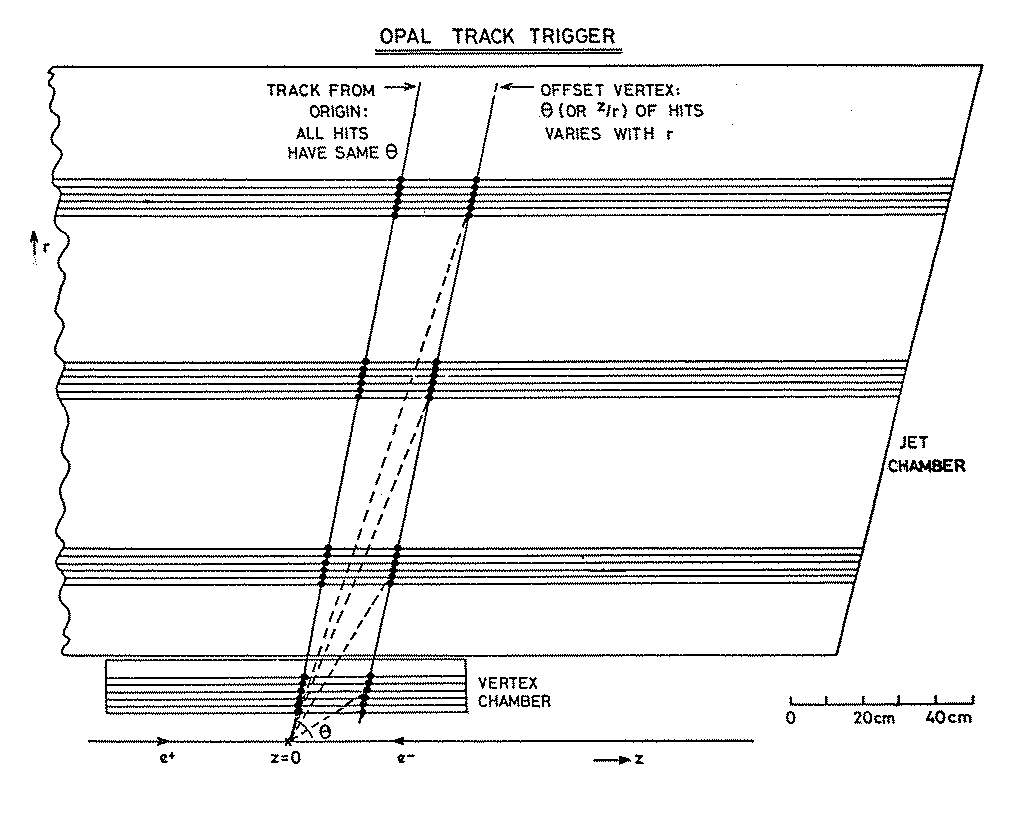
Bunches of electrons and positrons collide in LEP every 22 microseconds. The trigger of OPAL had the task of deciding, within this time, whether an interesting interaction had taken place. The track trigger was an essential component of this system, whose job was to decide whether there were any charged tracks emanating from the collision point. The time is too short for software to be used to analyse the data, so a dedicated hardware processor was designed at Cambridge, in collaboration with the RAL electronics group and QMUL.

The track trigger took data on the z-coordinate of hits from the vertex drift chamber, and from three groups of 12 wires in the main jet chamber. A track coming from the interaction region should show hits at the same value of z/r = cot(theta) on all wires, whereas a displaced track would show up at different values of z/r. The values of z/r are therefore histogrammed for each group of wires, and coincidences sought in order to supply a trigger. The angles of the tracks found are also passed to the central trigger, where associations with the outer detectors may be performed.

  • LBNE
  • LC-ABD/EuroTeV
  • MINOS
  • NA48
  • OPAL
    • Electromagnetic Endcap Calorimeter
    • Graphics
    • LEP1 Exclusive B Physics
    • LEP1 Perturbative QCD
    • LEP1 Precision Electroweak Physics
    • LEP2 QCD
    • LEP2 Two Fermion Production
    • LEP2 W Mass Measurement
    • Silicon MicroVertex Detector
    • Simulation
    • Track Trigger
    • Vertex Chamber
  • UA2
  • UA5
University of Cambridge

© 2026 University of Cambridge

  • University A-Z
  • Contact the University
  • Accessibility
  • Freedom of information
  • Terms and conditions

Study at Cambridge

  • Undergraduate
  • Graduate
  • International students
  • Continuing education
  • Executive and professional education
  • Courses in education

About the University

  • How the University and Colleges work
  • Visiting the University
  • Map
  • News
  • Events
  • Jobs
  • Giving to Cambridge

Research at Cambridge

  • News
  • Features
  • Discussion
  • Spotlight on...
  • About research at Cambridge