Home
High Energy Physics

Main navigation

  • Find us
    • General HEP contacts
    • Experimental Group
    • Theory Group
    • Technicians
    • Getting here
  • Research
    • Research overview
    • Experiment
    • Theory
    • Computational Radiotherapy
    • Intranet
    • Seminars
  • Opportunities
    • Opportunities overview
    • Job Opportunities
    • Graduate Admissions
    • Summer Studentships
  • Outreach
    • Overview
    • Previous Experiments
    • Masterclass (A/AS)
    • Muon Hodoscope
    • Cloud Chamber
    • Spark Chamber
User account menu
  • Log in

Breadcrumb

  1. Home
  2. Previous Experiments
  3. OPAL

LEP2 W Mass Measurement

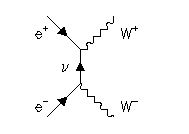
In 1996 the beam energy of LEP was increased so that pairs of weak W bosons may be formed. The first runs in 1996 were at a centre-of-mass energy of 161 GeV, and progressively increased to just over 200 GeV. The relevant Feynman diagrams for W+W- production are these:
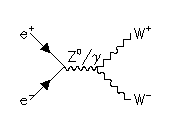
WW Feynman diagram WW Feynman diagram

One of the important measurements at LEP 2 is the precise measurement of the mass of the W, and this was studied at Cambridge. The mass of the W can be predicted indirectly from the existing measurements of the Z at LEP1, with an accuracy of about 0.03 GeV. A measurement at LEP 2 to this precision of better therefore forms an important test of the validity of the Standard Model.

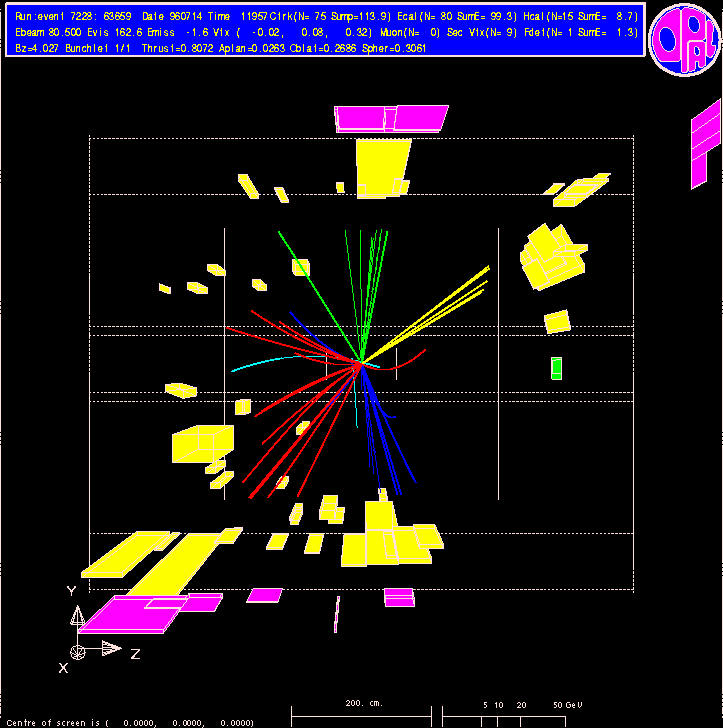
The W bosons can either decay to quark + antiquark, or to charged lepton + neutrino. If both Ws decay to quarks, the event is seen to have (at least) four jets of hadrons, as in this event.
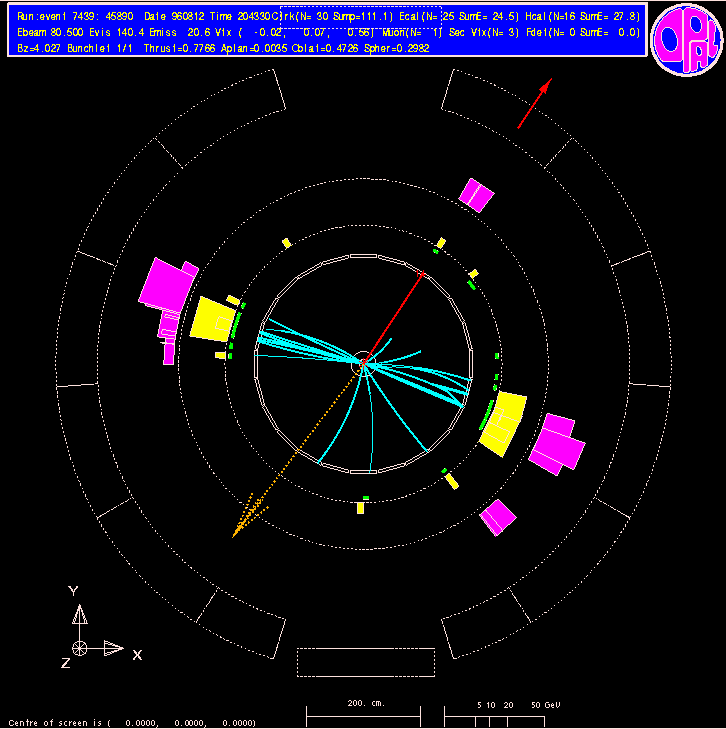
In the case where one W decays to quarks and the other to leptons, one typically sees two jets together with an isolated high energy lepton, as in this event where a high energy electron is marked in red. The missing momentum, which can be associated with the neutrino, is indicated by the arrow.
The mass of the W boson may be measured by directly reconstructing the invariant mass of pairs of jets. However, the selection of events is not completely free from background (from Z decays, or from incorrect pairings of jets in WW events). The plot below shows an example of the sort of mass peak we are able to reconstruct in OPAL using four-jet and events containing leptonic W decays. Based on our present results, we expect to be able to achieve a precision of 0.03 GeV on the W mass by the end of LEP 2, after combining results from all the LEP experiments.
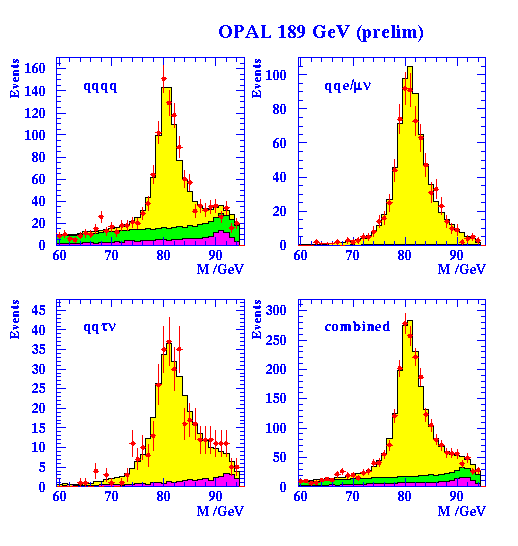
Mw plot
  • LBNE
  • LC-ABD/EuroTeV
  • MINOS
  • NA48
  • OPAL
    • Electromagnetic Endcap Calorimeter
    • Graphics
    • LEP1 Exclusive B Physics
    • LEP1 Perturbative QCD
    • LEP1 Precision Electroweak Physics
    • LEP2 QCD
    • LEP2 Two Fermion Production
    • LEP2 W Mass Measurement
    • Silicon MicroVertex Detector
    • Simulation
    • Track Trigger
    • Vertex Chamber
  • UA2
  • UA5
University of Cambridge

© 2026 University of Cambridge

  • University A-Z
  • Contact the University
  • Accessibility
  • Freedom of information
  • Terms and conditions

Study at Cambridge

  • Undergraduate
  • Graduate
  • International students
  • Continuing education
  • Executive and professional education
  • Courses in education

About the University

  • How the University and Colleges work
  • Visiting the University
  • Map
  • News
  • Events
  • Jobs
  • Giving to Cambridge

Research at Cambridge

  • News
  • Features
  • Discussion
  • Spotlight on...
  • About research at Cambridge