
Richard Batley, Adrian Bevan, Ranpal Dosanjh, Rick Galik (Visitor), Tim Gershon, Bruce Hay, Fabian Jansen, George Kalmus, Sven Katvars, Cristina Lazzeroni, Roger Moore, David Munday, Matt Needham, Kirsten Nelson, Manny Olaiya, Andy Parker, Mitesh Patel, Steve Takach, Tom White, Steve Wotton
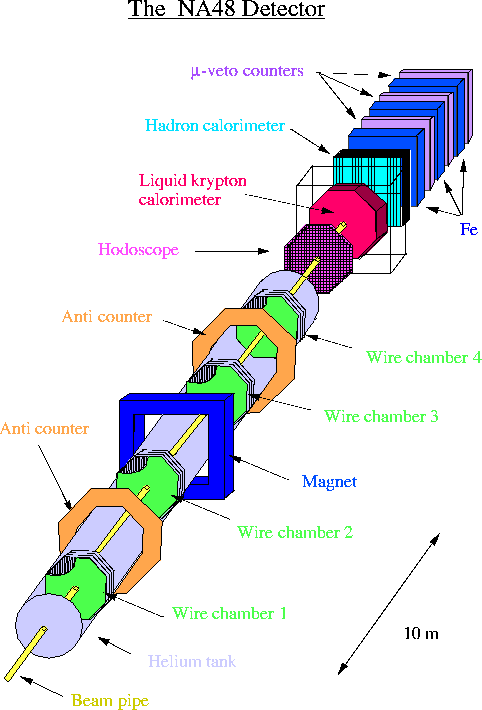
NA48 was an experiment at CERN to study CP violation. The collaboration had about 150 physicists from more than 15 institutes.
The experiment used a nearly collinear arrangement of KS and KL meson beams produced using protons from the CERN SPS. These mesons decayed into pions in the detector and observations of the decay rates allowed measurement of CP symmetry.
The theory of CP violation explains decays in which matter and anti-matter behave differently. The study of this effect therefore has direct bearing on the question of the origin of the asymmetry between matter and antimatter.
The Cambridge group were responsible for the design, construction, installation, commissioning and operation of large planes of muon detecting counters and their associated high speed electronics; and for studying, understanding and minimising sources of background in the KS and KL beams. We have been active in data-taking, which began in 1997, and ended for the symmetry violation measurements in 2001.
Subsequently the programme shifted to studying extremely rare KS decays. With only minor changes to the existing experiment, a unique opportunity arose to exploit a high intensity KS beam. These studies allowed further constraints to be imposed on the CP violation parameters, tests of Chiral Perturbation theory and measurements of hyperon decays.
A two-day test run in 1999 with a factor ~200 increase over the existing KS beam intensity yielded a decay branching ratio limit better than the best published result. A further high intensity KS run took place in 2000, with about 50 days data-taking, that resulted in several new measurements. Following this, phase II of the programme increased the beam intensity by a factor of ~600 and a further 120 days of data taking