

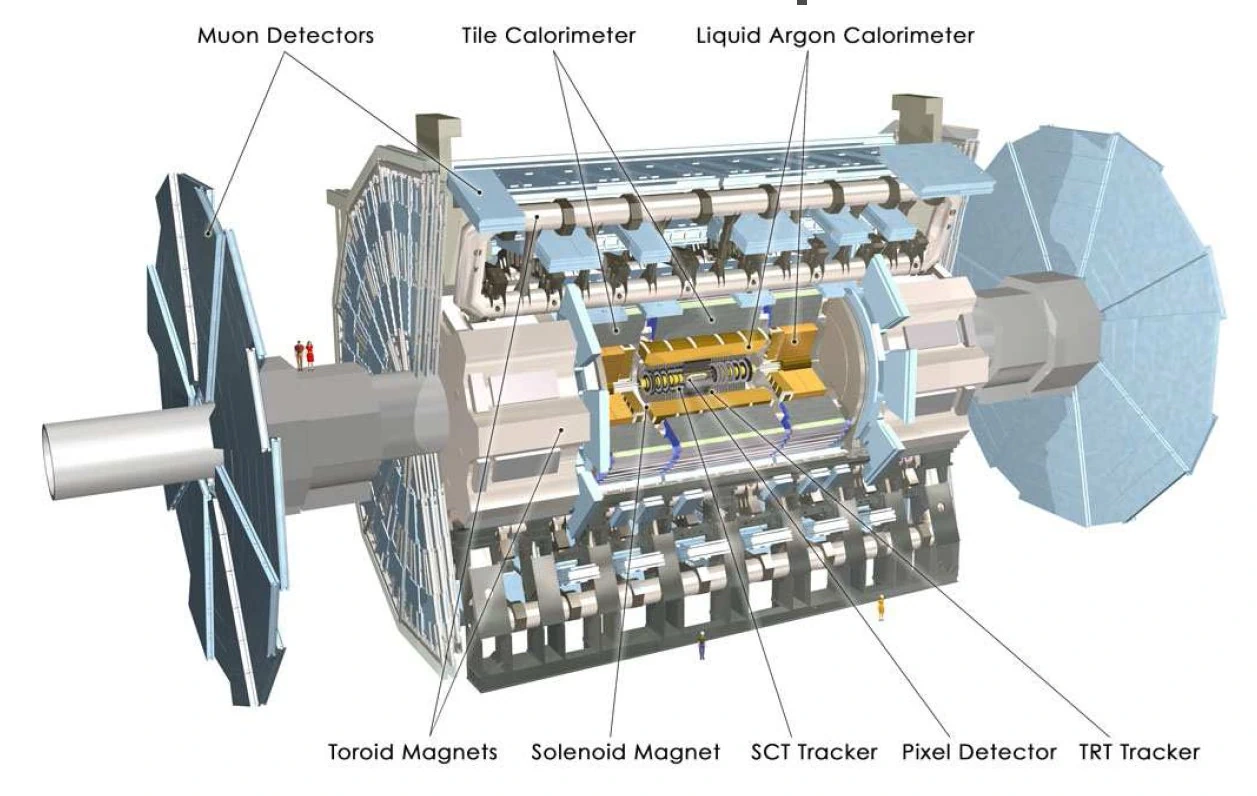
The ATLAS detector is one of the two major general purpose experiments for the LHC (Large Hadron Collider) at CERN.
The LHC is the world's largest and highest-energy particle accelerator. It will collide two beams head-on at very high energies (14 TeV), which will recreate the conditions just after the Big Bang. International collaborations of physicists will analyse the particles created in the collisions using special detectors in a number of experiments, among which ATLAS (A Toroidal LHC ApparatuS) is the largest one.
Starting in early-2009, the ATLAS detector began searching for new discoveries in the head-on collisions of protons of extraordinarily high energy energy. The very high particle production rates (~1000 particles every 25 ns) and very high energies present a formidable technical challenge. ATLAS is one of the largest collaborative efforts ever attempted in the physical sciences.
There are more than 3000 physicists and engineers from over 174 institutions in 38 countries, including over 1000 students, working together on ATLAS.
Semiconductor Tracker
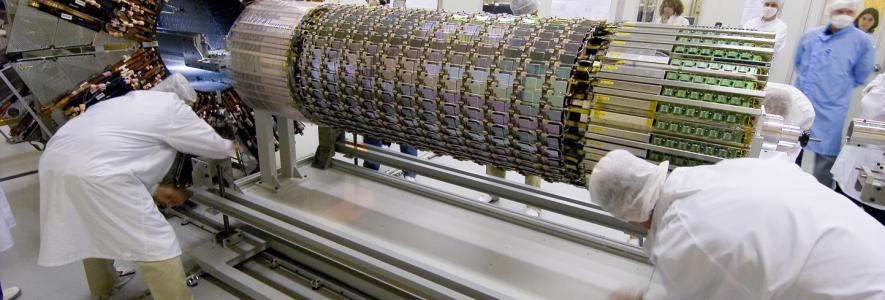
The Cambridge ATLAS group has made a major contribution to the hardware of the experiment through the development, production and quality control of silicon microstrip sensors, modules and readout electronics for use in the ATLAS semiconductor tracker (SCT). The SCT is essential for tracking particles as they emerge from the collision region. The group also plays a leading role in the development of the data acquisition and monitoring for the online commissioning, calibration and readout of the SCT, and in the SCT offline software. The group will be deeply involved in the analysis of the vast amount of data which will be generated by this experiment over the next 15 to 20 years.
Standard Model Analyses
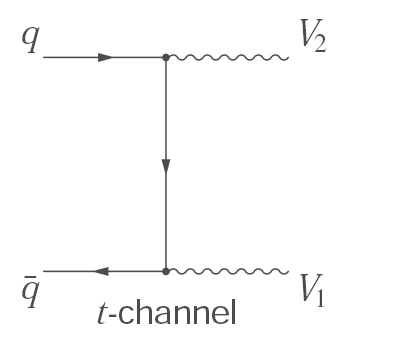
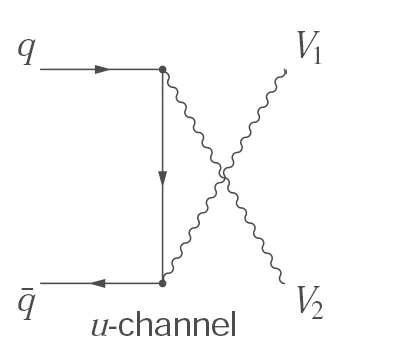
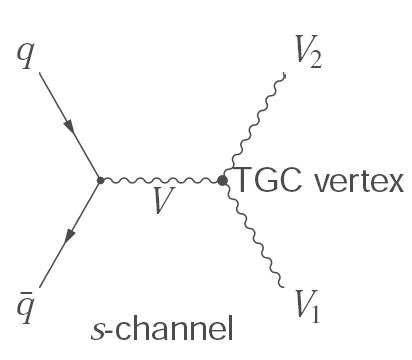
Observations of p-p collisions at the LHC will test the Standard Model at the highest energies yet achieved on Earth (14 TeV). Precision measurements of Standard Model processes will be vital at ATLAS, both to test the theory and to understand possible backgrounds to new physics.
The Cambridge ATLAS group is currently interested in diboson events. We are currently working on a measurement of the ZZ cross-section.
The three diagrams above are the Standard Model tree-level diboson production diagrams, where V, V1, V2 = (W, Z, γ).
The s-channel diagram contains the trilinear gauge boson vertex:
- Only WWg and WWZ allowed in the SM
- Measuring Anomalous Triple Gauge Couplings (TGC) probes new physics.
In order to investigate possible Anomalous Triple Gauge Couplings, we are investigating events in which two Z-bosons are produced. We will attempt to use these events to set limits on γZZ and ZZZ couplings, which are zero in the standard model.
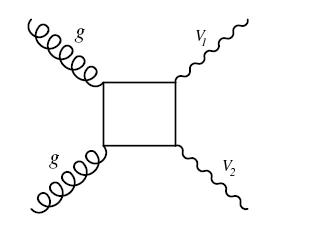
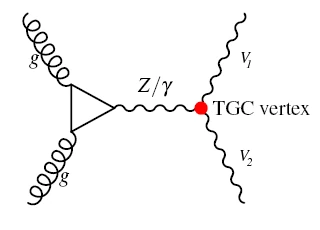
The Next-to-Leading Order (NLO) cross-section for ZZ production at the LHC is calculated to be 15 pb. However, this does not include the contribution from the process of gluon-fusion, which can also produce two Z-bosons. Gluon-fusion is shown in the above two diagrams. Although there is no tree-level contribution for this process it makes a significant O(15%) contribution to the total ZZ production cross-section. In order to set limits on any Anomalous Triple Gauge Couplings these the effect of these diagrams must be taken into account in any predictions.
Beyond the Standard Model Analyses
Supersymmetry is an attractive extension to the Standard Model, linking matter and forces, and predicts a large number of new particle states, which could be observed in the mass range to be explored by LHC. The Cambridge ATLAS group is currently involved in searches for Electroweak SUSY production, Third Generation SUSY production and R-Parity violating SUSY.
Other models suggest that extra space dimensions could be detected, through processes such as black hole production. The Cambridge ATLAS group is currently involved in searches for Black Holes and Di-boson resonances.
Strategies for Discovering New Physics at the LHC
A team in Cambridge is investigating possible signatures for supersymmetric processes and other new physics beyond the Standard Model, which could be observed at the Large Hadron Collider. The Cambridge Pheno Working Group is a collaboration between members of the Cambridge ATLAS group and theorists from the Cavendish Theory Group and the Department of Applied Mathematics and Theoretical Physics.
The HERWIG Monte Carlo programme, developed by the Cavendish HEP group and now used throughout the world to model high energy particle collisions, is used by the group to model possible new processes and to simulate the events which would be observed at LHC. A computer model of the ATLAS detector is then used to determine which final states can best be used to discover evidence for new physics, and to measure the underlying parameters of the theory.